|
Rabbit Remote Control 0.1.0-bate16
|
Loading...
Searching...
No Matches
|
Rabbit Remote Control 0.1.0-bate16
|
Parameter interface. More...
#include <Parameter.h>
Signals | |
| void | sigChanged () |
| emit when the parameter changes Usually if required, the corresponding parameter corresponds to a change event. | |
Public Member Functions | |
| CParameter (QObject *parent, const QString &szPrefix=QString()) | |
| virtual int | Load (QString szFile=QString()) |
| Load from file. | |
| virtual int | Save (QString szFile=QString(), bool bForce=true) |
| Save to file. | |
| virtual int | Load (QSettings &set) |
| Load from QSettings. | |
| virtual int | Save (QSettings &set, bool bForce=true) |
| Save to QSettings. | |
| virtual bool | CheckValidity () |
| Check whether the parameter is valid to decide whether to use or save the parameter. | |
Protected Member Functions | |
| virtual int | OnLoad (QSettings &set)=0 |
| virtual int | OnSave (QSettings &set)=0 |
| virtual bool | OnCheckValidity () |
| Check validity. | |
| int | SetModified (bool bModified=true) |
| When setting parameters, if there is a modification, it is called. | |
| bool | GetModified () |
| Whether the parameters have been modified. | |
Properties | |
| bool | Modified |
Private Member Functions | |
| int | AddCategory (CParameter *p) |
| Instances of this class and its derived classes are members of the instance. | |
| QString | GetPrefix () const |
| int | SetPrefix (const QString &szPrefix) |
Private Attributes | |
| QString | m_szPrefix |
| bool | m_bModified |
| If false, then don't save when save. | |
| QVector< CParameter * > | m_Category |
| Category. | |
Parameter interface.
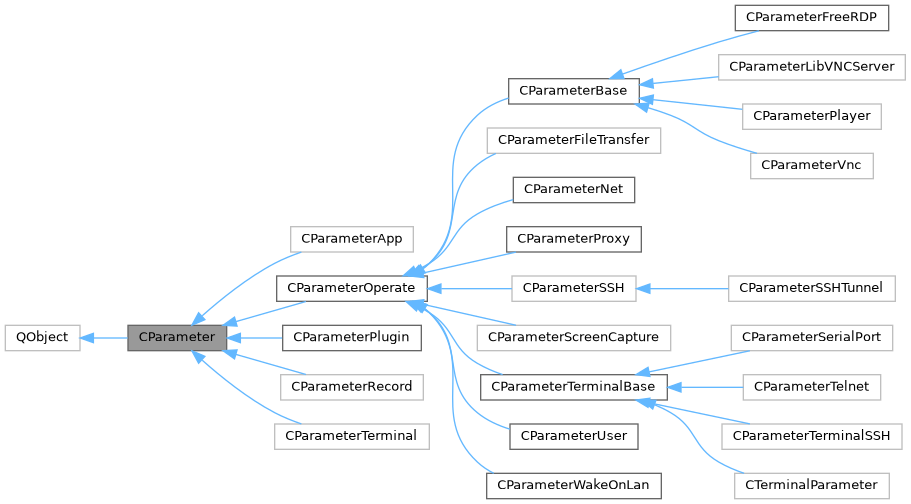
Because there may be many parameters, it is necessary to classify them by parameter category. Each category can derive a separate class from this class. Each category is then used as a member variable in the derived classes of this class.
For example:
Connection parameters include the following categories:
Then the connection parameters can be a combination of the above categories:
Definition at line 219 of file Parameter.h.
|
explicit |
| parent |
|
| szPrefix | Prefix |
| szPrefix | 前缀。 |
|
virtual |
Definition at line 21 of file Parameter.cpp.
|
private |
Instances of this class and its derived classes are members of the instance.
Definition at line 134 of file Parameter.cpp.
|
virtual |
Check whether the parameter is valid to decide whether to use or save the parameter.
Derived classes typically simply overload OnCheckValidity() to check the parameters.
For example, when setting the parameters in the dialog, you need to check whether the parameters are complete or valid before you can save them.
Definition at line 103 of file Parameter.cpp.
|
protected |
Whether the parameters have been modified.
GetModified
Definition at line 121 of file Parameter.cpp.
|
private |
Definition at line 24 of file Parameter.cpp.
|
virtual |
Load from QSettings.
Definition at line 60 of file Parameter.cpp.
|
virtual |
Load from file.
Definition at line 35 of file Parameter.cpp.
|
protectedvirtual |
Check validity.
Reimplemented in CParameterVnc, and CParameterWakeOnLan.
Definition at line 115 of file Parameter.cpp.
|
protectedpure virtual |
Implemented in CParameterNet, CParameterPlugin, and CParameterWakeOnLan.
|
protectedpure virtual |
Implemented in CParameterPlugin.
|
virtual |
Save to QSettings.
Definition at line 81 of file Parameter.cpp.
|
virtual |
Save to file.
Definition at line 47 of file Parameter.cpp.
|
protected |
When setting parameters, if there is a modification, it is called.
| bModified |
Definition at line 126 of file Parameter.cpp.
|
private |
Definition at line 29 of file Parameter.cpp.
|
private |
If false, then don't save when save.
Definition at line 345 of file Parameter.h.
|
private |
Category.
Definition at line 351 of file Parameter.h.
|
private |
Definition at line 337 of file Parameter.h.
|
readwrite |
Definition at line 222 of file Parameter.h.